
Going Public “For Real”
Anthony Bernier, Project Director, YouthFacts.org | March 2026
White young people just walked in the front door of the Greenville, South Carolina, main library in 1959. Not so for 18 year old Jesse Jackson (1941-2026). The books Jackson wanted to read during his freshman Christmas break from University of Illinois took a lot more.
Jackson’s local McBee Avenue Colored Branch didn’t own what Jackson wanted to read. Instead, the McBee librarian used a favor and wrote a personal note to get him an appointment with the main Whites-only Greenville County library staff.
Even with his note, Jackson had to use the main library’s rear entrance. The librarian read his note and responded “It’ll take at least six days to get these books.”
Reasonably, Jackson replied, “Couldn’t I just go back in the shelves and look for them… where nobody else would see me?”
“You cannot have the books now…” the librarian answered, “that’s the way it is.”
A policeman, standing nearby (probably because of the advance appointment), joined in, “You heard what she said.”
Jackson, the future civil rights titan, reportedly stormed out the library’s back door. He circled around to the front of the building and read the inscription written in its granite entablature,
“That thing says public, and my father is a veteran and pays taxes.”
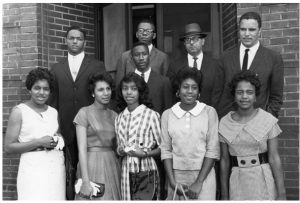
1960, The Greenville Eight (Greenville County Library Website). Jesse Jackson upper left.
Jackson vowed to return over the summer promising to make the library “go public for real.”
Jackson, good to his word, returned to Greenville later in the summer, and, along with 7 other young people, entered the main library and mounted a 45-minute sit in. They became known as the “Greenville Eight,” mostly kids from Sterling High School (5 girls and 3 boys).
The library director promptly called police who arrested them all for “disorderly conduct.”
According to the American Library Association, later that fall, Greenville became South Carolina’s first public library to desegregate in response to Black community activism. 1
Among all of Jesse Jackson’s myriad civil and human rights campaigns, throughout his long and productive life of progressive activism, his career as an activist began as a teenager at his local public library.
Of course, this story also begs questions about the myths libraries continue to tell about being “free for all.” Today’s criticism of racist public policies targeting the Black community, and Black peoples’ often heroic struggles to overcome them, rather obscures legacies of how public libraries complied with racial segregation. Further, the story illustrates the American Library Association’s still unacknowledged complacency and silence in how the institution looked the other way for decades. 2
Such civic heroism also rests uneasily against the vision that public libraries generally hold of young people – as needy, skill-lacking, individual information consumers. Upon learning the history of reform and innovation young people initiated libraries would do well to revise their visions of youth.
But an equally pertinent story resides, especially for our YouthFacts readers, in how young people, teenagers (Jesse Jackson was a teenager himself in 1960) led the movement to integrate their public libraries. This story of young people at the forefront of the broader movement to integrate public services also documents the leading roles young people assumed across the nation. And, like so many histoires of social movements, it ignores the roles young people so often play in pursuing social justice, as I pointed out in my previous critique of Ken Burn’s new documentary of the American Revolution (see my December 2025 YouthFacts.org blog post).
1 George M. Eberhart, “The Greenville Eight: The Sit-in that Integrated the Greenville (S. C.) Library, American Libraries, 1 June 2017.
2 For a critique of public library reluctance to reconcile its complicity with racial segregation, see Wayne A. Wiegand, “Sanitizing American Library History: Reflections of a Library Historian, Library Quarterly: Information, Community, Policy 90, no. 2, pages 103-120. For specifics on Jackson’s Greenville library protest, see, Wayne A. Wiegand and Shirley A. Wiegand, The Desegregation of Public Libraries in the Jim Crow South: Civil Rights and Local Activism. Baton Rouge: Louisiana State University Press, 2018.