
Mike Males, Principal Investigator, YouthFacts.org| August 2026
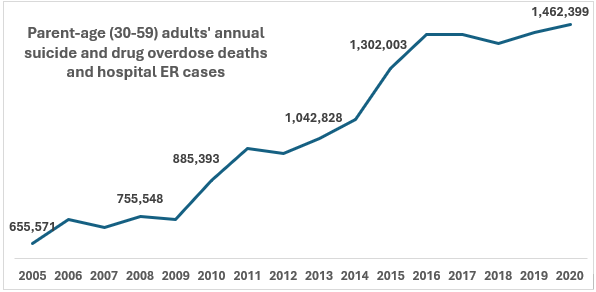
Source: Centers for Disease Control, Mortality data; Fatal and Nonfatal injury reports .
Amid skyrocketing deaths and hospitalizations for suicidal and drug abuse causes (which measure only a fraction of the adult addiction crisis) among grownups of age to be parents, parents’ partners, relatives, teachers, coaches, etc., around teenagers, the Centers for Disease Control’s latest biannual Youth Risk Behavior Survey finds:
- Nearly one-third of teens ages 13-18 reported having lived with parents and household adults who abused drugs and/or alcohol;
- One-third had lived with parents/adults with “severe” mental health problems;
- Over 60% had suffered grownups in their homes who were violent, psychologically abusive, and/or had been jailed.
CDC statisticians analyzed the data from its 20,000 teen respondents and – in an obscure report – associated parental/adults’ abuses, violence, addiction, and mental problems at home with two-thirds of teenagers’ poor mental health, five-sixth of teens’ opiate abuse, and nearly 90% of teens’ suicide attempts.
Authorities couldn’t care less.
In the late 2010s, the CDC and authorities loudly proclaimed a “teenage mental health crisis” (as they do in practically every generation). The top-level stampede among political leaders, academics, and advocates, to fawning media coverage, blamed teenagers themselves using social media and smartphones for their increasing mental distress.
However, the CDC had analyzed that issue, too. Their report found that even treating social media as the only factor in young lives, “frequent social media use” was associated with fewer than 10% of teens’ mental health issues and none of teens’ suicide attempts.
Again, authorities couldn’t care less what our own leading health agency found. They were so obsessed with blaming social media they simply dismissed widespread abuses and serious family adversities victimizing children and teenagers.
Ban teenagers from social media! Take away their smartphones! That will fix the “teenage mental health crisis,” the major consensus declares.
The official obsession is getting worse.
Further analysis of the CDC survey, like the few studies to examine abuse issues, found that severely abused teenagers use social media an average of 2 hours a day more than non-abused teens. Why? As Pew Research’s 2022 and 2025 surveys found, large majorities of teens use social media to keep up with friends, express themselves, feel more accepted, and connect with “people who can help them get through tough times.”
Since abused teens also report more vastly mental health issues and other risky behaviors – hardly surprising – false correlation has led superficial and ill-motivated authorities simply to blame their social media use.
Lately, an even darker turn has emerged. New Mexico Attorney General Raúl Torrez posted pictures of real children in a “sting” operation that drew “inappropriate” solicitations from “numerous” pedophiles seeking 13-year-olds. So, did the state’s chief law enforcement officer vigorously pursue identifying, referring, and prosecuting these “numerous” real-life predators menacing children?
He did not. He destroyed evidence of real-life pedophiles endangering children.
Instead, Torrez filed a splashy, headline-grabbing civil suit against social-media giants Meta and Instagram alleging they “addicted” teens to online platforms where predators might lurk. State court jurors awarded his office $375 million. Political and interest groups led by ban-teens-from-social-media crusaders cheered lustily.
The Los Angeles “social media addiction” civil lawsuit last year against Meta was even more appalling. A mother whose years of violent, psychological, body-shaming abuses and abandonments had destroyed her daughters (one attempted suicide, the other testified to years of trauma) miraculously resurfaced when the opportunity to sue social media arose. The court, confined only to apportioning blame to the named plaintiffs, awarded her and one surviving daughter $6 million as if she were a “victim.” She also won accolades from politicians and interests, led by ban-teens-from-social-media crusaders.
That Big Tech deserves monetary punishments, along with legislation to break up their monopolies, censorious tactics, and commercial profiteering. Instead, lawmakers, in the name of “protecting children!”, are handing eager Big Tech giants Meta, X, Anthropic, Google, etc., vastly more biometric, credit card, identification, and related intimate personal data on users (child, teen, and adult alike) in phony “age verification” schemes. Research from Australia and of smartphone bans is already proving such schemes unworkable, but no matter – authorities keep pushing them across the globe.
These ominous trends expose a cabal of established interests who no longer care about widespread abuses and adversities victimizing children and teenagers. Instead, banning teens from social media under the phony war cry of “protecting children!” is really aimed at suppressing young people’s inconvenient political opinions on climate change, Israel, democracy, and economic justice, the overriding goal of increasingly authoritarian governments allied with Big Tech oligarchs.